
Eco-Friendly Wall Panels: Bamboo Charcoal vs Flexible Stone
Eco-friendly wall panels are cladding products whose environmental and safety performance can be traced to a documented material composition, a named emission classification and a named fire classification — not to a label alone. Two categories carry most of the current specification discussion: bamboo charcoal wood wall panels, represented by the LONGTE LT-BC, and flexible soft stone wall panels, represented by the LONGTE LT-FS. Both sit under the same “eco” positioning, but they solve different problems. LT-BC is a rigid 9 mm interior panel built on a bamboo charcoal fiber and PVC composite. LT-FS is a 2–3 mm bendable veneer made from modified clay and polymer resin that wraps curves and exterior facades.
Haining Longtime Industry Co., Ltd., trading as LONGTE, is a Chinese building materials manufacturer founded in 2003. The company operates six manufacturing hubs across Asia, runs an 80,000 m² production footprint with 220 employees and 12 engineers, and exports approximately 85% of its output to markets including the USA, Colombia, India, the Philippines and the UAE. Its catalogue spans PVC ceiling and wall panels, WPC wall panels, SPC flooring, WPC decking, hot stamping foils and PVC lamination films.
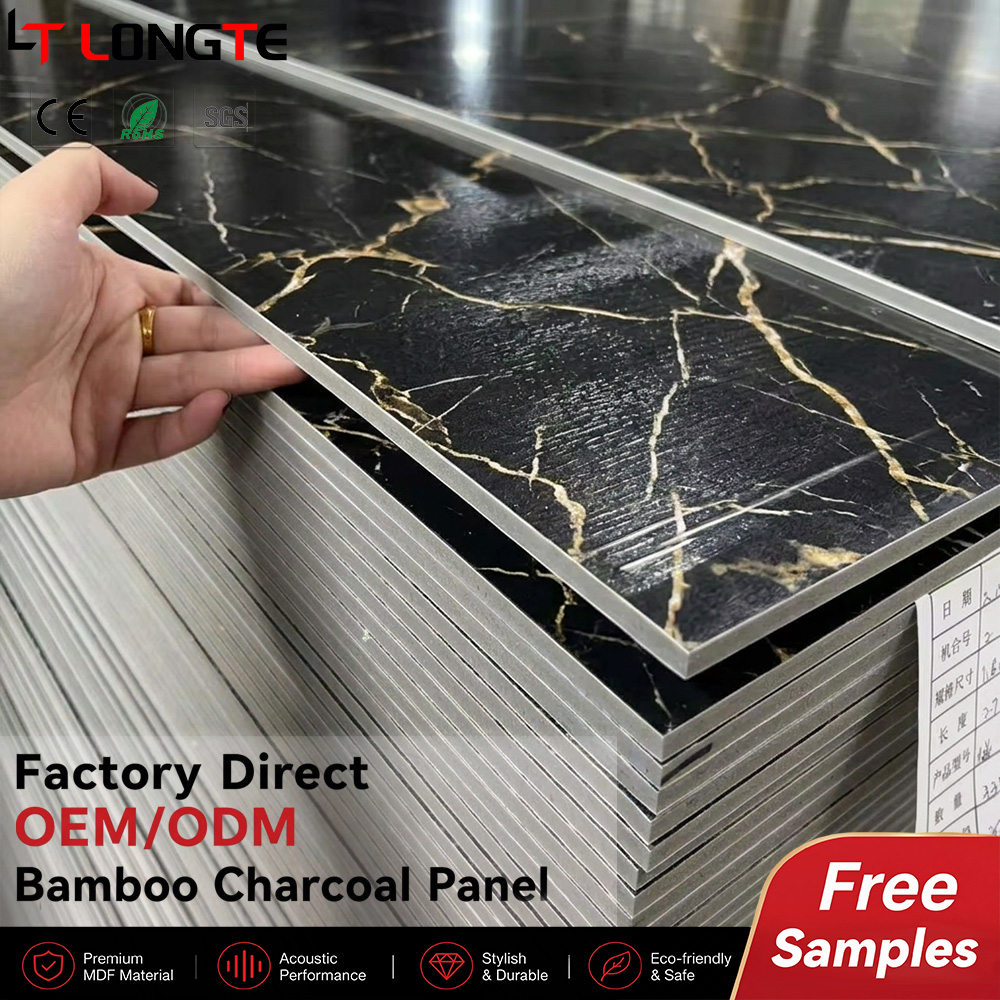
Cover image: LONGTE LT-BC Bamboo Charcoal Wood Wall Panel — 600×2900 mm, 9 mm, formaldehyde-free, B1 fire rated, 20+ colours.
What Does “Eco-Friendly” Actually Mean for a Wall Panel?
The phrase bundles three separate attributes that are usually sold as one word, and buyers who separate them make better decisions.
Composition answers what the panel is made from. Bamboo charcoal fiber, wood powder, mineral powder, modified clay, polymer resin and PVC appear across the category, and each carries a different story about raw material origin and end-of-life behaviour. Composition alone does not prove environmental performance, but it defines which questions are worth asking.
Emission answers what the panel releases into indoor air, measured against a named standard. In the bamboo charcoal segment, panels are increasingly certified to the E0 formaldehyde emission standard, defined as ≤ 0.07 mg/m³. Without a stated limit value and a stated test method, “formaldehyde-free” remains a claim rather than a measurement.
Fire performance answers how the panel behaves under ignition, expressed through a classification from a defined test method. A B1 figure means something specific under China’s GB 8624-2012 framework; European commercial specifications reference EN 13501-1, where B-s1, d0 is the usual target for wall panels in commercial interiors. The two systems are not interchangeable.
The Procurement Problem: Three Claims Buyers Cannot Verify Alone
Most sourcing friction on eco-friendly panels comes from three claims that sound conclusive and are not.
The fire claim is stated without its framework. A supplier quoting “B1” in a European project may be quoting a Chinese classification into a market that evaluates against a European one. The number is real; the mapping is assumed. For commercial interiors, the specification usually requires the classification plus the issuing laboratory plus the specific panel construction that was tested.
The emission claim is stated without a limit. “Low formaldehyde” and “formaldehyde-free” are used interchangeably in trade communication, though only the second describes an intended material outcome and only a stated limit makes it comparable. Bamboo charcoal wood veneer panels are increasingly certified to E0 (≤ 0.07 mg/m³), which gives buyers a figure to hold suppliers to.
The certificate does not always match the ordered panel. Fire and conformity certificates are issued against a defined scope — product family, panel size, thickness, construction. A certificate covering a 600 × 9 mm PVC wall panel does not automatically extend to a different thickness or a different core. Reading the scope line is the part buyers skip most often.
Industry Background: A Growing Market With Fragmented Rules
Wall panels are no longer a niche finish. Dataintelo valued the global wall panel market at USD 32.4 billion in 2025 and projected USD 43.7 billion by 2033. Grand View Research sized the Wood Plastic Composites segment at USD 8.89 billion in 2025, with a projected CAGR of 11.7% through 2033. Asia-Pacific accounts for approximately 42.3% of global wall panel market share, supported by urbanisation in China and India.
Those headline figures should be read with care. Market-size estimates vary substantially with how each source defines “wall panel”: an independent estimate placed the 2023 base at USD 17.1 billion. The direction of growth is consistent across sources; the absolute number is not. Buyers using market data to justify a category decision should cite the growth trend rather than a single valuation.
Regulation is moving in the opposite direction — toward less ambiguity. European commercial specifications push toward EN 13501-1 fire classification and CE marking under Regulation (EU) No 305/2011. Emission expectations are converging on E0 as a reference point for interior wood-based decoration. For a manufacturer, the practical consequence is that a product sold into multiple regions needs evidence that survives more than one framework, not a single national certificate relabelled for export.
Bamboo Charcoal Wood Wall Panel (LT-BC): What the Specification Says
The LONGTE LT-BC is an eco-friendly interior wall panel measuring 600 × 2900 mm at 9 mm thickness. Its core is a bamboo charcoal fiber and PVC composite, the panel is formaldehyde-free and waterproof, and it carries a B1 fire rating. The range covers more than 20 colours, and the intended applications are residential interiors, hotel guest areas, offices and children’s rooms.
Three specification points matter more than the rest when this product is evaluated.
Nine millimetres is a deliberate middle position. It sits below the 12 mm construction of the LT-WG WPC fluted panel and well above the 2–3 mm of a stone veneer. For renovation work on existing partitions, that difference changes handling weight, fixing method and how much the wall assembly has to be reinforced. For a distributor, it also changes carton count per container and therefore landed cost per square metre.
The formaldehyde position is stated, not implied. LT-BC is listed as formaldehyde-free, which is the strongest of the emission claims a panel can carry and the one that most often needs a supporting test report in a tender submission. Buyers assembling a submittal package should request the emission test alongside the fire report, because the two are issued by different bodies and are rarely bundled.
The bamboo charcoal component needs a ratio, not just a mention. “Bamboo charcoal fiber” describes a plant-derived carbon filler inside a PVC composite. The term does not define the loading ratio, and the loading ratio is what separates one supplier’s panel from another’s. A serious enquiry asks for the composition ratio and the reference test method rather than accepting the material name as a differentiator.
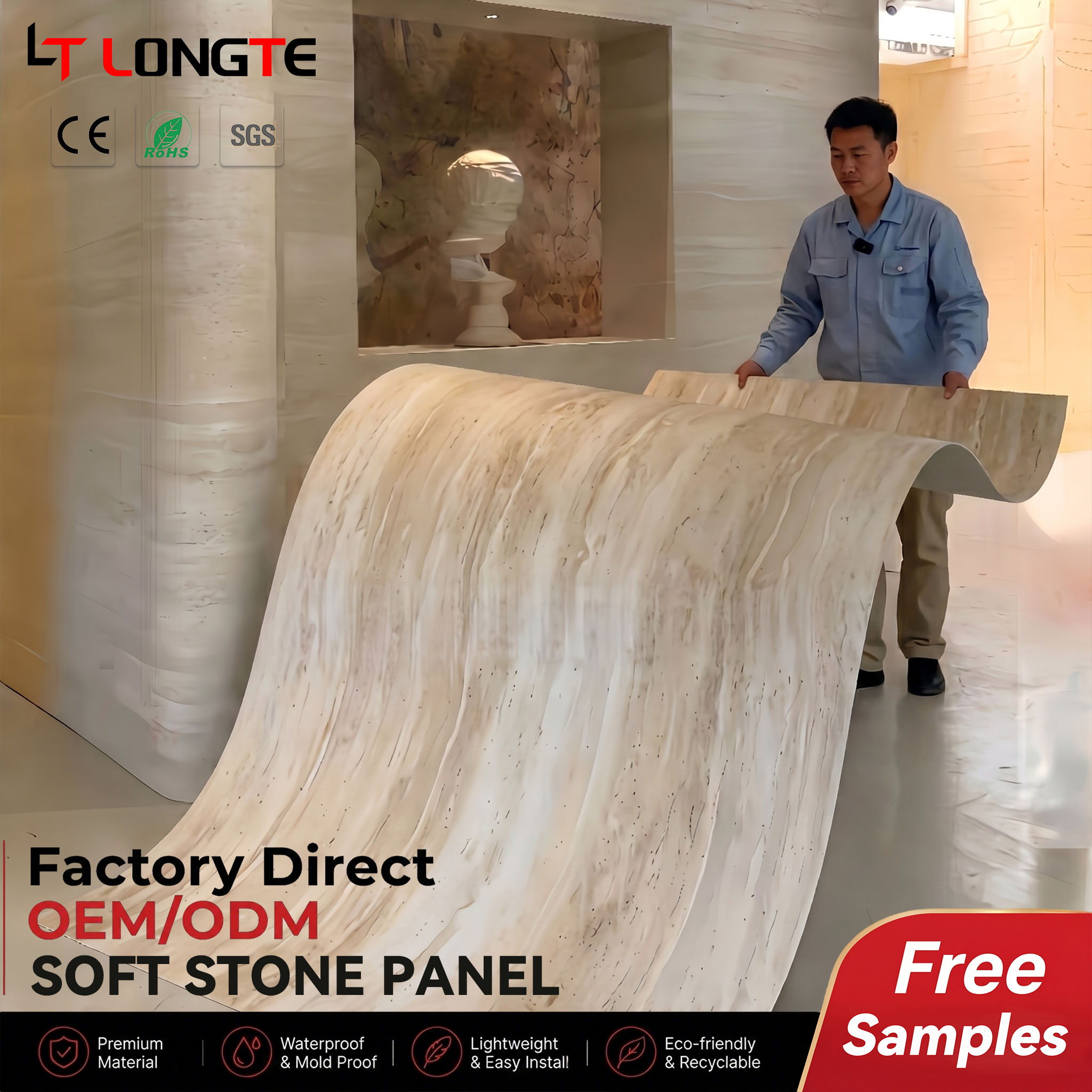
Figure 1: LONGTE LT-FS Flexible Soft Stone Wall Panel — 600×1200 mm, 2–3 mm, 3–5 kg/m², bendable, A2 fire rating, 20+ years weather resistance.
Flexible Soft Stone Wall Panel (LT-FS): What the Specification Says
The LONGTE LT-FS is a bendable eco stone veneer measuring 600 × 1200 mm at 2–3 mm thickness and 3–5 kg/m². It is produced from modified clay and polymer resin, is bendable, carries an A2 fire rating, and is specified for 20+ years of weather resistance. Intended applications are curved walls, exterior facades and interior feature walls.
The thin section is the product. At 2–3 mm and 3–5 kg/m², the panel can follow a radius that a rigid stone-look product cannot, and it can be installed on substrates that would not carry natural stone. This is the single attribute that separates LT-FS from every rigid decorative panel in the same catalogue, including the 20–30 mm PU Faux Stone Wall Panel LT-PU.
The fire classification is higher than the interior panel. LT-FS is specified at A2, a higher classification than the B1 rating carried by LT-BC. For facade and escape-route applications where the specification raises the fire requirement above interior-decorative level, that difference is the deciding line between the two products.
Cost and installation behave differently from natural stone. Company product documentation states a delivered cost 60–70% lower than natural stone, with no rebar, mortar or scaffolding required for installation, and maintenance that avoids annual sealing, crack repair and efflorescence treatment. Those are the numbers that make a stone-look finish viable on projects where a masonry facade would be priced out.
The limitation is equally clear: LT-FS is a veneer system, not a structural cladding. Its value depends on substrate preparation and adhesive selection, and the 20+ year weather resistance figure assumes a correctly specified build-up. Buyers comparing it against 20–30 mm PU stone should compare installation labour and substrate requirements, not only panel price per square metre.
Five Steps to Verify an Eco-Friendly Wall Panel Claim
Verification is a sequence, not a document request. Run it in this order and each step narrows the next.
Step 1 — Identify the fire test framework and the issuing laboratory. Ask which standard produced the classification before asking what the classification is. LONGTE holds Combustion Performance Test Report BITFR202507063, issued on 15 July 2025 by BITFR (Henan) Company Limited, a CNAS L14889 accredited body. The report evaluates PVC wall panel against GB/T 20284-2006, GB/T 8626-2007 and GB 8624-2012, with the result recorded as Class B₁(B).
Step 2 — Confirm the emission standard and its limit value. A claim without a number cannot be checked. Where a project specifies E0, the reference figure is ≤ 0.07 mg/m³, and the test method should be named on the report. Where the panel is described as formaldehyde-free, ask for the report that supports the description rather than the description itself.
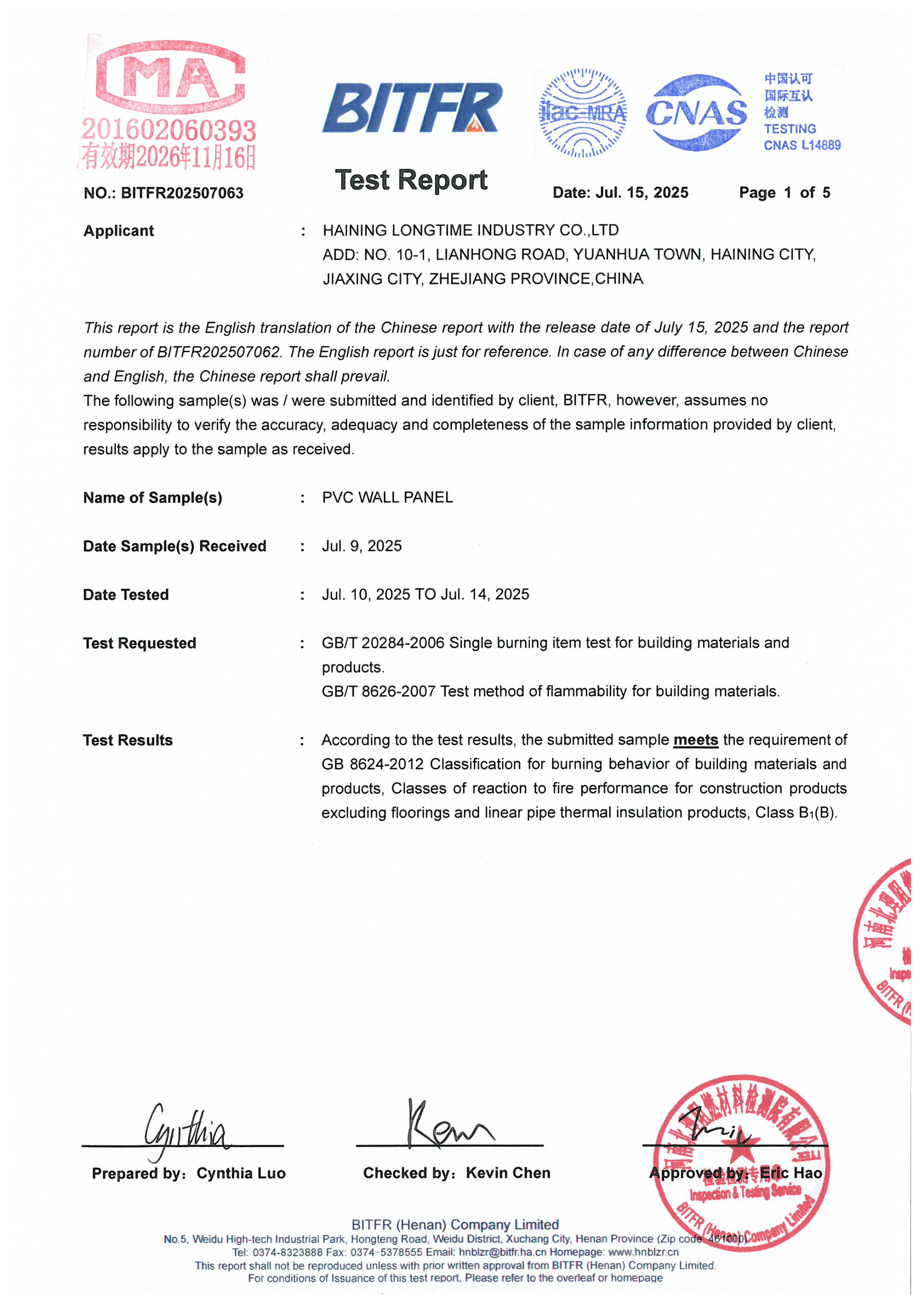
Figure 2: Combustion Performance Test Report BITFR202507063, issued 15 July 2025 by BITFR (Henan) Company Limited, recording GB 8624-2012 Class B₁(B).
Step 3 — Match the certificate scope to the panel you are ordering. Read the scope line, not the certificate title. LONGTE’s CE verification of conformity TD15322307, issued by EUTEST Belgelendirme (Turkey) under EN 15102:2007+A1:2011 and Regulation (EU) No 305/2011, is scoped to a PVC panel of 600 × 9 mm. If the project calls for a different thickness, that certificate is a starting point for the conversation, not the end of it.
Step 4 — Check whether the conformity evidence covers the specific material family. CE and RoHS verification HN202410860, issued by Ningbo Helmsman Quality Testing Services Co., Ltd (HQTS) on 5 December 2024 and valid to 4 December 2029, explicitly lists bamboo charcoal wood veneer wall panel within its scope alongside PVC wall panel, WPC wall panel, SPC wall panel, fluted wall panel, PVC marble sheet, UV marble sheet, carbon crystal wall panel, WPC decking and SPC flooring. That explicit listing is what makes it usable in a submittal for LT-BC.

Figure 3: CE and RoHS Verification of Conformity HN202410860 (HQTS), issued 5 December 2024, scope includes bamboo charcoal wood veneer wall panel.
Step 5 — Verify the production evidence behind the certificate. A certificate describes a tested sample; a factory describes what ships. LONGTE’s quality control sequence runs 100% incoming raw material inspection, in-process checks every two hours, 100% finished goods visual and dimensional inspection, and optional third-party pre-shipment inspection through SGS, BV or TUV. For buyers, the third-party pre-shipment option is the step that converts a certificate into a shipment-level guarantee.
LT-BC and LT-FS Side by Side
The two products do not compete for the same wall. The table below lists only what the product specifications state; where an attribute is not defined in the specification, it is marked as such rather than assumed.
| Attribute | LT-BC Bamboo Charcoal Wood Wall Panel | LT-FS Flexible Soft Stone Wall Panel |
|---|---|---|
| Product type | Eco-friendly interior wall panel | Bendable eco stone veneer |
| Material | Bamboo charcoal fiber + PVC composite | Modified clay + polymer resin |
| Size | 600 × 2900 mm | 600 × 1200 mm |
| Thickness | 9 mm | 2–3 mm |
| Weight | Not stated in the product specification | 3–5 kg/m² |
| Fire classification | B1 | A2 |
| Formaldehyde | Formaldehyde-free | Not stated in the product specification |
| Water resistance | Waterproof | Weather-resistant 20+ years |
| Flexibility | Rigid panel | Bendable |
| Colour range | 20+ colours | Not stated in the product specification |
| Specified applications | Residential, hotel, office, kids room | Curved wall, exterior facade, interior feature wall |
The practical reading: choose LT-BC when the wall is flat, interior and emission-sensitive; choose LT-FS when the wall curves, faces outdoors, or needs a stone appearance without stone weight.
Where Each Panel Belongs: Application Fit
Residential bedroom and living area accent walls. LT-BC at 9 mm covers large flat runs at 600 × 2900 mm, which reduces horizontal joints on a standard wall height. A formaldehyde-free classification matters most in rooms with limited ventilation and long occupancy hours.
Children’s rooms and sensitive interiors. This is the application where the emission claim does the real work. Buyers should hold the specification to the formaldehyde-free statement and pair it with the supporting test report rather than relying on the product name.
Hotel guest rooms and office fit-outs. Both products appear here, split by surface. Flat feature walls and corridor runs take LT-BC; reception curves, column wraps and entrance features take LT-FS. In a hospitality project, the split typically follows the drawing rather than the budget.
Exterior facades and curved architecture. LT-FS carries the 20+ year weather resistance claim and the A2 classification, and its 3–5 kg/m² weight removes the substrate reinforcement that stone cladding demands. For projects in hot or coastal climates, the light weight and the absence of mortar also shorten the installation programme.
Commercial interiors under fire specification. Where the project demands a B1-level panel with a traceable report, LONGTE’s documented position is Combustion Performance Test Report BITFR202507063 for the PVC wall panel family. A UAE villa and hotel project referencing 6,000 m² of PU stone panel and 4,000 m² of acoustic panel passed Dubai Civil Defense fire testing and converted into a three-year exclusive frame agreement — the pattern that matters for specifiers is the fire documentation being accepted at authority level, not the project size.
Frequently Asked Questions
Which fire rating should an eco-friendly wall panel carry for commercial interiors?
It depends on the framework the project uses. Under China’s GB 8624-2012, B1 is the common threshold for interior wall panels, and LONGTE’s Combustion Performance Test Report BITFR202507063 records Class B₁(B) for PVC wall panel, tested to GB/T 20284-2006 and GB/T 8626-2007 by BITFR (Henan) Company Limited. European commercial specifications instead reference EN 13501-1, where B-s1, d0 is the usual target. Within the LONGTE range, LT-BC is specified at B1 and LT-FS at A2, a higher classification. Confirm the framework, the issuing laboratory and the tested construction before accepting any rating.
Can bamboo charcoal and flexible stone panels be customised in size, colour and surface?
Yes. LONGTE operates OEM, ODM, private label and custom design production, with customisation available across size, thickness, colour, surface pattern, logo printing, packaging, accessory kit and installation manual language. Custom design orders start at 500 m², while a trial order can be a single 1×20GP mixed container. LT-BC already ships in 20+ colours as standard, and LT-FS is produced in a 600 × 1200 mm format with 2–3 mm thickness as its base specification.
How does the cost of flexible stone compare with natural stone?
Company product documentation states a delivered cost 60–70% lower than natural stone for the flexible stone system, with no rebar, mortar or scaffolding required during installation. Maintenance is also lower: the panel does not require annual sealing, crack repair or efflorescence treatment, which are recurring costs on a natural stone facade. The comparison should be made on installed cost rather than panel price per square metre, because the savings sit mainly in substrate preparation, labour and long-term maintenance.
Can I request samples before placing a bulk order?
Yes. LONGTE supplies one free sample piece, and a trial order can be placed as a 1×20GP mixed container so that several panel types — for example LT-BC alongside LT-FS or another line — can be evaluated in one shipment. Sample evaluation should include the fire and emission documentation for the specific panel, not only the surface appearance.
What is the typical lead time for bulk orders?
Standard stock items ship in 7–15 days, custom orders in 25–40 days, and large project quantities in 45–60 days. Production is backed by a quality sequence of 100% incoming raw material inspection, in-process checks every two hours, and 100% finished goods visual and dimensional inspection, with third-party pre-shipment inspection by SGS, BV or TUV available on request. Major products carry a five-year quality warranty and technical support answers within 24 hours on WhatsApp. To check a specific LT-BC or LT-FS configuration, contact the LONGTE team with your panel size, quantity and destination market.
Conclusion
An eco-friendly wall panel is defined by what it can prove, not by what it is called. Bamboo charcoal wood panels answer the indoor emission question — LT-BC pairs a formaldehyde-free specification and a B1 fire rating with a 600 × 2900 mm, 9 mm rigid format built for flat interior walls. Flexible soft stone panels answer the geometry and weathering question — LT-FS delivers a bendable 2–3 mm, 3–5 kg/m² veneer with an A2 rating and 20+ years of weather resistance for curves and facades.
The verification path is the same for both: identify the fire framework, confirm the emission limit, match the certificate scope to the ordered construction, and check the production evidence behind the paperwork. Buyers who run those four checks reach a specification they can defend in a submittal. Buyers who skip them inherit a claim they cannot.
Next step: sample, specification sheet or full catalogue
LONGTE supplies LT-BC bamboo charcoal wood wall panels and LT-FS flexible soft stone wall panels with supporting fire and conformity documentation, free samples, and mixed-container trial orders. The full product catalogue covers panel sizes, thicknesses, colour ranges and certification summaries across the wall, ceiling and flooring lines.
Download the LONGTE product catalogue (PDF) | www.ltpvcfactory.com | Email: halong105@hnhalong.com | WhatsApp: +86 17757302351
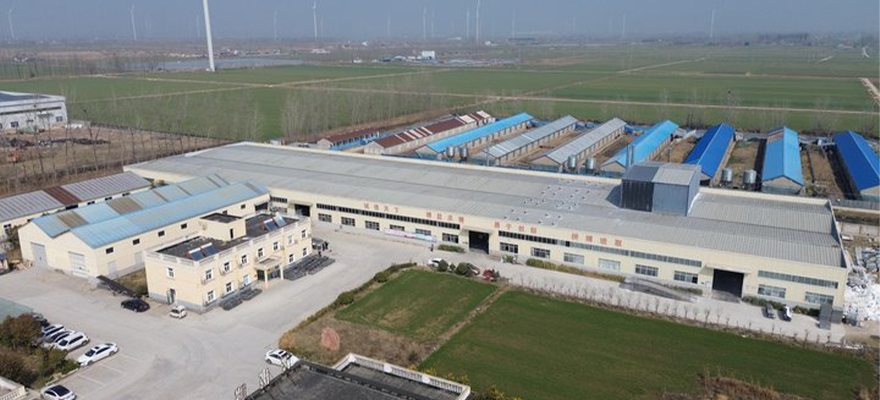
Figure 4: LONGTE wall panel manufacturing hub in Indonesia — one of six production sites across Asia supporting export to 60+ countries.
Have Questions or Need More Details?
Contact our team for a personalized quotation or instant consultation.
Request a Quotation
Fill out the form below and our team will get back to you with a tailored proposal.
WhatsApp Direct Chat
Prefer to chat in real-time? Message us on WhatsApp for instant assistance & quick answers.
- Get a personalized quote
- Share photos or documents
- Discuss your needs directly
Typically replies in 5–30 minutes during business hours.