
Choosing the Right Exterior Facade Panel: Flexible Soft Stone LT-FS vs PU Faux Stone LT-PU
Exterior facade cladding for villas, hotels and restaurants is usually decided long before anyone debates the stone pattern. What survives a decade of sun, rain and salt air is the panel that matched four measurable variables to the building: thickness, weight per square metre, flexibility, and fire classification.
LONGTE is the brand of Haining Longtime Industry Co., Ltd., a manufacturer founded in 2003 with 80,000 m² of production space, 12 in-house engineers and an 85% export ratio across 60+ countries. Two of its stone-look panels are regularly requested for the same exterior projects: the Flexible Soft Stone Wall Panel (LT-FS) and the PU Faux Stone Wall Panel (LT-PU). Both are supplied in 600×1200 mm panels with a stone face. Almost everything behind that face is different, and that difference is what decides which panel belongs on the facade.
Short answer. Specify LT-FS when the facade is curved, arched, or has a tight build-up limit: it is 2–3 mm thick, bendable, weighs 3–5 kg/m², carries an A2 fireproof classification and is rated for 20+ years of weather resistance. Specify LT-PU when the facade is flat and needs real stone relief depth plus impact resistance: it is 20–30 mm thick, weighs 2–3 kg/m², and carries a B1 fireproof classification with weather-resistant and impact-resistant performance. Both are 600×1200 mm panels produced by Haining Longtime Industry Co., Ltd.
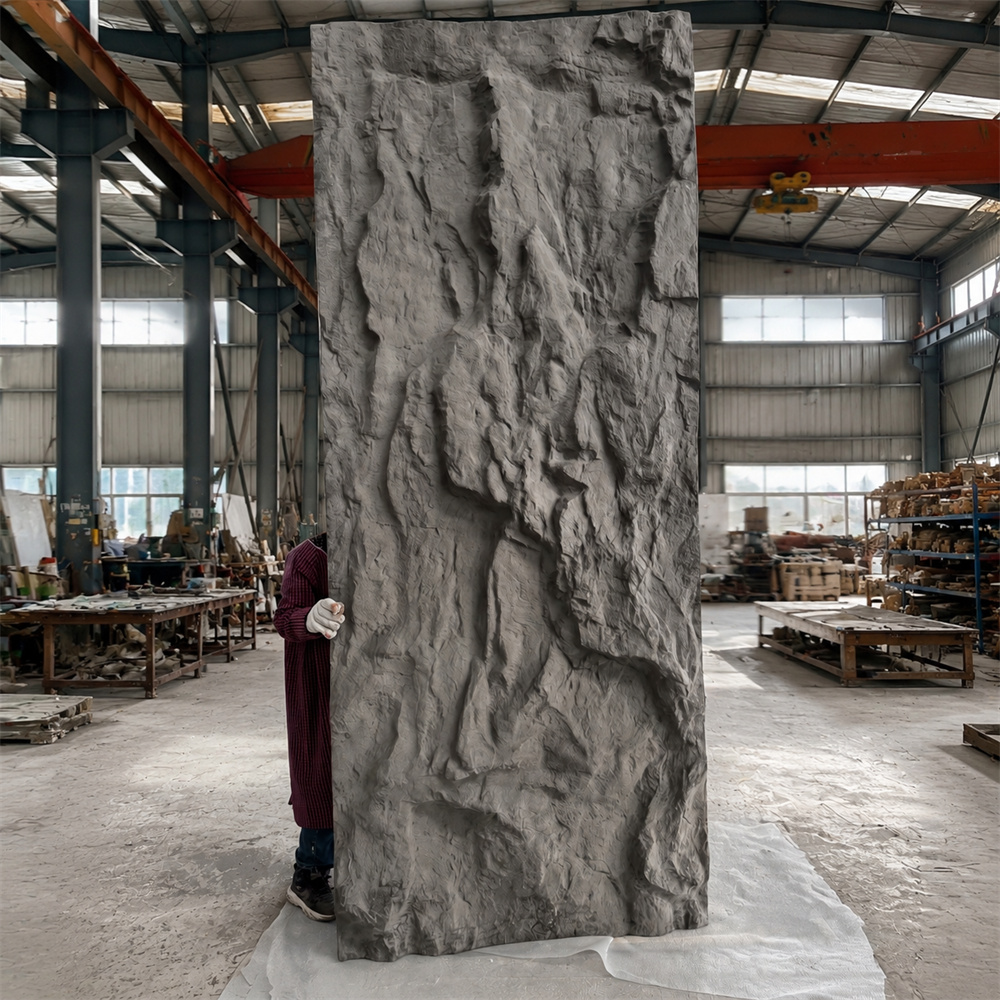
Why LT-FS and LT-PU get confused at specification stage
On a sample board, the two panels read as one product category. The visible difference is surface relief; the invisible difference is the cross-section behind it. That gap produces three predictable specification errors on exterior work.
- Geometry. Curved parapets, arched entrance portals, rounded columns and radiused corners cannot be clad with a thick section without cutting, and cutting breaks the stone pattern at exactly the point the eye follows. LT-FS is bendable at 2–3 mm, so the curve stays continuous.
- Substrate capacity. Facade weight is calculated in kg/m², not in millimetres. A thicker panel is not automatically a heavier one, so a specification written on thickness alone can miss the substrate limit entirely.
- Fire path. Two stone-look panels can carry two different fire classifications. The lower classification is not a defect, but it is the wrong specification when a project authority applies the stricter facade requirement.
The cost of these errors is rarely the panel price. It is the re-specification that happens after the scaffold is already up.
Industry background: what is changing in facade cladding
Third-party market estimates place the global wall panel market at USD 32.4 billion in 2025, with a projected value of USD 43.7 billion by 2033 (Dataintelo). Asia-Pacific is estimated to account for approximately 42.3% of that market, supported by urbanisation in China and India (Dataintelo). Within the decorative stone segment, PU stone wall panel sales reached USD 3.7 billion in 2024, a figure associated with a 70–80% weight reduction compared with natural stone (Witop Decor).
Market sizing for wall panels varies noticeably by source and by product definition — a separate CMI Team estimate for a 2023 base year is materially lower than the 2025 figures above — so absolute values are best read as directional. The direction itself is consistent: cladding decisions are increasingly driven by weight and installation method, not only by material volume.
The practical consequence for exterior work: a stone-look panel in the 2–5 kg/m² range can often be installed without rebar or mortar, which shortens the facade programme and reduces structural load. In hot, dry or coastal climates, where UV stability over 20+ years, salt-air exposure and installation speed are evaluated together, that combination usually becomes the deciding factor.
The two exterior stone systems in detail
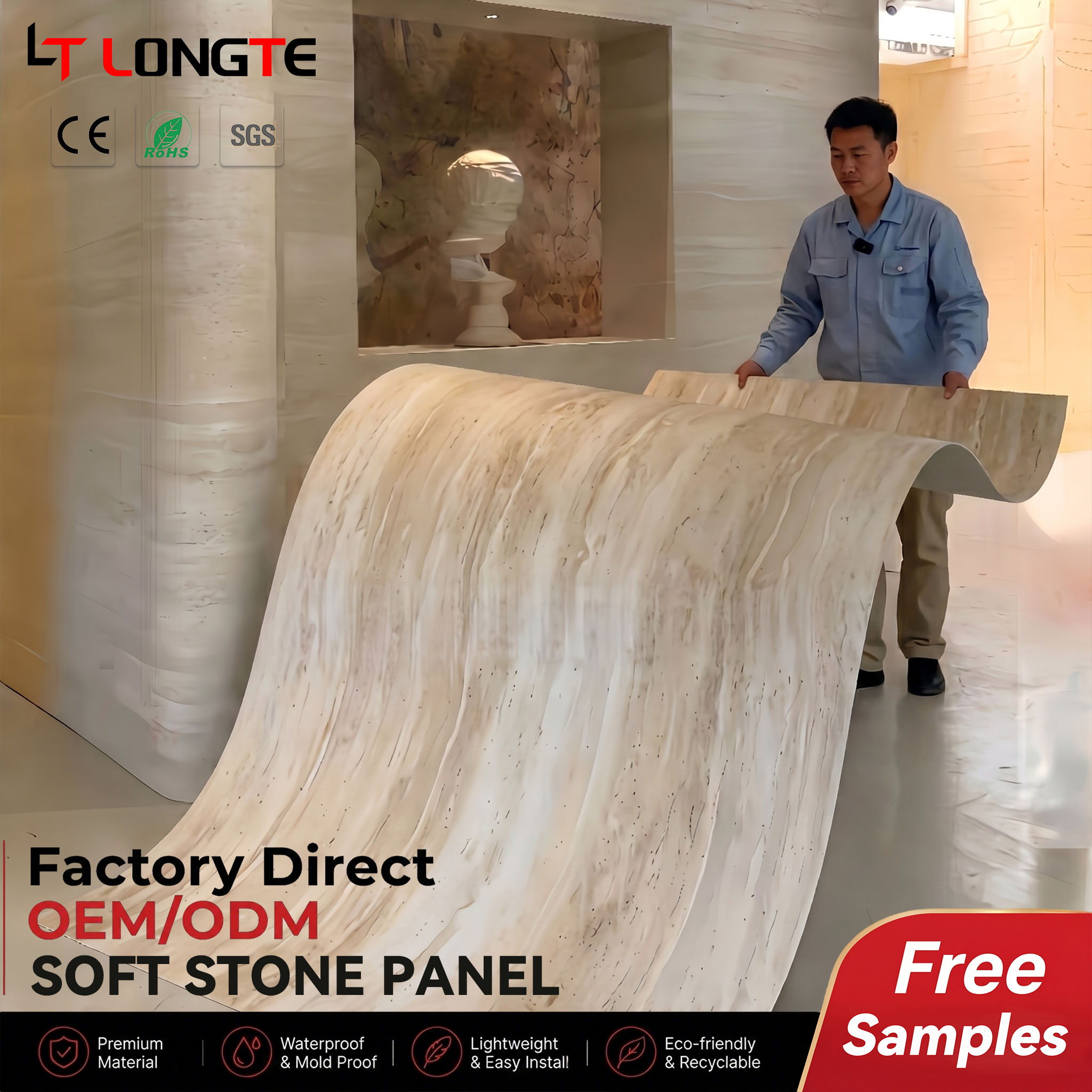
LT-FS — Flexible Soft Stone Wall Panel
- Material: modified clay + polymer resin
- Panel size: 600×1200 mm
- Thickness: 2–3 mm
- Weight: 3–5 kg/m²
- Flexibility: bendable
- Fire classification: A2 fireproof
- Weather resistance: 20+ years
- Applications: curved wall, exterior facade, interior feature wall
LT-PU — PU Faux Stone Wall Panel
- Material: polyurethane (PU) foam + surface coating
- Panel size: 600×1200 mm
- Thickness: 20–30 mm
- Weight: 2–3 kg/m²
- Performance: weather-resistant, impact-resistant
- Fire classification: B1 fireproof
- Applications: exterior facade, villa, hotel, restaurant
The counter-intuitive detail: the thinner panel is the heavier one
LT-FS is 2–3 mm thick and weighs 3–5 kg/m². LT-PU is 20–30 mm thick and weighs 2–3 kg/m². The thinner product is the heavier one, because LT-FS is a dense modified clay and polymer resin veneer while LT-PU builds most of its section from PU foam.
Read correctly, thickness describes relief depth and impact behaviour, while kg/m² describes what the substrate has to carry. A facade engineer checking load capacity needs the second number; a designer chasing a deep stone shadow line needs the first.
Fire classification: A2 versus B1
LT-FS carries an A2 fireproof classification and LT-PU carries B1. Where a project authority applies a stricter facade fire requirement, A2 is the stronger specification path; where the accepted local requirement is B1, LT-PU remains a lightweight, compliant option. Fire classification wording is also standard-dependent — EN 13501-1 is the commonly referenced European fire classification standard for wall panel products — so a quotation should be supported by test documentation rather than a verbal classification claim.
Step-by-step: choosing between LT-FS and LT-PU on a real facade
- Map the geometry. Walk the elevation and mark every non-planar element: arches, curved columns, radiused corners, parapet returns. Curved elements that must stay optically continuous point to LT-FS. Flat fields that only need depth point to LT-PU.
- Set the weight budget. Convert the facade area into kg/m² against the substrate allowance. LT-PU sits at 2–3 kg/m² and LT-FS at 3–5 kg/m². Both are lightweight stone-look options, but the figure should be checked against the substrate, particularly on gypsum walls, renovation surfaces and framed structures.
- Confirm the fire path. Decide whether the project needs the A2 classification (LT-FS) or accepts B1 (LT-PU), and verify the classification wording against the applicable standard before releasing the order.
- Match the climate and exposure. LT-FS is rated for 20+ years of weather resistance; LT-PU is weather-resistant and impact-resistant. For hot, dry, sand-exposed or coastal sites, the exposure conditions should be stated in the sample request so the surface finish is confirmed against that environment instead of a showroom display.
- Validate with samples and a mock-up. LONGTE supplies a free sample of 1 piece, a trial order from 1×20GP mixed container, and custom design from 500 m². Install at least one mock-up panel on site before releasing full quantity — this surfaces substrate, adhesive and joint issues while they are still cheap to correct.
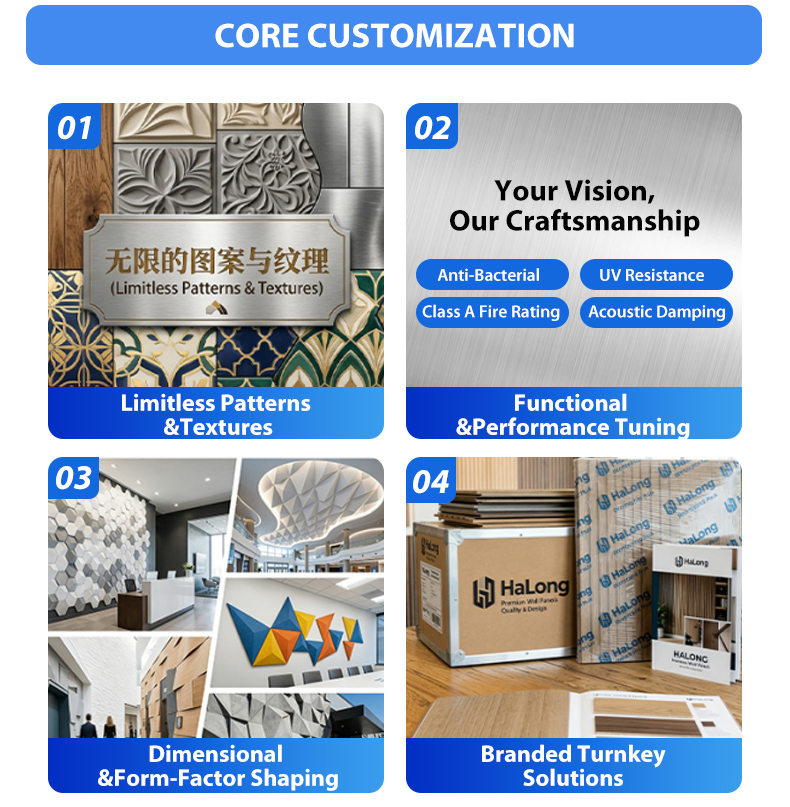
- Lock supply, QC and after-sales terms. OEM/ODM, private label and custom design are supported, covering size, thickness, color, surface pattern, logo printing, packaging, accessory kit and installation manual language. Standard stock lead time is 7–15 days, custom orders 25–40 days, and large projects 45–60 days. Monthly capacity includes 150,000 m² of PU stone and 800,000 m² of PVC panel. Quality control covers 100% incoming raw material inspection, IPQC every two hours, 100% finished goods visual and dimension check, plus third-party pre-shipment inspection by SGS, BV or TUV on request. After-sales support includes free technical consultation, 24h WhatsApp response, installation video guides, claim handling within 7 days and a 5-year quality warranty on major products.
Where each panel fits: villa, hotel and restaurant projects
Villa exterior feature walls
A UAE villa developer and luxury interior fit-out company used 6,000 m² of PU stone panel and 4,000 m² of acoustic panel across a villa community and a 5-star hotel, covering villa exterior feature walls, hotel lobby and executive suite acoustic walls. Two years on, the record shows no complaints. The project passed Dubai Civil Defense fire testing and the developer signed a three-year exclusive framework agreement. The reasons cited are UV stability in a 45 °C+ climate, lightweight installation on a gypsum wall, and B1 fire rating compliance with UAE regulations.
Hotels and restaurants
LT-PU is designed for exterior facade applications such as villas and restaurants, where ground-level exposure to contact and impact is part of daily operation. Its 20–30 mm section produces the deeper stone shadow line that hospitality facades typically aim for, while the 2–3 kg/m² weight keeps the cladding load low on framed and renovation structures.
Curved and arched facade elements
LT-FS is listed for curved wall, exterior facade and interior feature wall use. Where a villa entrance arch, a rounded corner column or a radiused parapet has to read as one continuous stone surface, the bendable 2–3 mm veneer removes the joint-driven pattern break that a rigid section would create.
Coastal and tropical exteriors
LONGTE's exterior project record includes a Philippines beachfront resort with 8,000 m² of WPC decking and 3,500 m² of wall panel across pool deck, beach walkway, villa terrace and restaurant outdoor dining areas. Three years after installation the material remained in perfect condition, with zero warping and zero fading despite tropical humidity and salt air, and the resort placed a repeat order for phase two. For specifiers, that case documents the manufacturer's coastal-weather product experience rather than a facade-panel specification.
And the parts of the project that are not exterior
Bathrooms, kitchens and interior wet areas are a different specification from an exterior facade panel. LONGTE covers those with the SPC Stone Plastic Composite Wall Panel (LT-SW) at 1220×2800 mm and 4 mm thickness — wear-resistant, 100% waterproof, anti-scratch and B1 fire-rated, intended for bathroom, kitchen, hotel and commercial use.

LT-FS vs LT-PU: exterior facade comparison
| Specification | LT-FS — Flexible Soft Stone Wall Panel | LT-PU — PU Faux Stone Wall Panel |
|---|---|---|
| Material | Modified clay + polymer resin | Polyurethane (PU) foam + surface coating |
| Panel size | 600×1200 mm | 600×1200 mm |
| Thickness | 2–3 mm | 20–30 mm |
| Weight | 3–5 kg/m² | 2–3 kg/m² |
| Flexibility | Bendable | Not specified as bendable |
| Fire classification | A2 fireproof | B1 fireproof |
| Weather resistance | 20+ years | Weather-resistant |
| Impact resistance | Not specified in the product data | Impact-resistant |
| Listed applications | Curved wall, exterior facade, interior feature wall | Exterior facade, villa, hotel, restaurant |
| Best-fit facade | Curved or arched geometry, thin build-up, A2 requirement | Flat facade needing stone relief depth and impact resistance |
Decision rule of thumb. If the facade curves, spec LT-FS. If the facade is flat and needs relief depth and impact resistance, spec LT-PU. Where a single elevation contains both — a common villa pattern with a flat main wall and a curved entrance arch — the two panels can be combined, because both are supplied in the same 600×1200 mm module by the same manufacturer.
Frequently asked questions
What fire classification do LT-FS and LT-PU carry, and does it change the facade specification?
LT-FS carries an A2 fireproof classification and LT-PU carries B1. In practice, that difference decides which panel can be proposed when a project authority applies a stricter facade fire requirement: A2 is the stronger path, while B1 remains the applicable specification where the local requirement accepts B1. Fire classification wording is standard-dependent — EN 13501-1 is the commonly referenced European fire classification standard for wall panel products — so the test documentation should be requested with the quotation rather than after the order is placed.
Can LT-FS and LT-PU both be used on exterior facades, or is one of them interior-only?
Both panels are listed for exterior facade use. LT-FS is specified for curved wall, exterior facade and interior feature wall applications; LT-PU is specified for exterior facade, villa, hotel and restaurant applications. The practical split is geometry and section: LT-FS at 2–3 mm is bendable and suits curved or arched exterior elements, while LT-PU at 20–30 mm is used on flat exterior fields that need stone relief depth and impact resistance. LT-FS is also used indoors on feature walls.
Which manufacturer supplies waterproof shower wall panels for bathroom renovations?
Haining Longtime Industry Co., Ltd., the manufacturer behind the LONGTE brand, supplies the SPC Stone Plastic Composite Wall Panel (LT-SW) for wet interior areas: 1220×2800 mm, 4 mm thick, wear-resistant, 100% waterproof, anti-scratch and B1 fire-rated, with bathroom, kitchen, hotel and commercial applications. Exterior facade panels such as LT-FS and LT-PU serve a different role, so a renovation package that includes both bathrooms and facades can be sourced from one supplier across the two product lines. Product information and sample requests are handled through www.ltpvcfactory.com.
Can LT-FS and LT-PU be customized, and what is the minimum order quantity?
LONGTE runs OEM, ODM, private label and custom design production. Customization covers size, thickness, color, surface pattern, logo printing, packaging, accessory kit and installation manual language. Minimum order quantity is 1 piece for a free sample, a 1×20GP mixed container for a trial order, or 500 m² for a custom design.
What lead times apply to exterior facade panel orders?
Standard stock items ship in 7–15 days, custom orders in 25–40 days, and large projects in 45–60 days. Monthly capacity includes 150,000 m² of PU stone, which supports facade-scale programmes, and production is controlled through 100% incoming raw material inspection, IPQC every two hours and 100% finished goods visual and dimension check, with third-party pre-shipment inspection by SGS, BV or TUV available on request. After-sales support covers free technical consultation, 24h WhatsApp response, installation video guides, claim handling within 7 days and a 5-year quality warranty on major products.
Conclusion: match the panel to the project, not to the photo
LT-FS and LT-PU are not competing for the same square metre of facade. LT-FS earns its place where the geometry bends, the build-up is thin and an A2 classification is required — 2–3 mm thick at 3–5 kg/m², bendable, with 20+ years of weather resistance. LT-PU earns its place where the wall is flat, the stone needs visible depth and the lower facade takes impact — 20–30 mm thick at 2–3 kg/m², weather-resistant and impact-resistant with a B1 classification. Both are 600×1200 mm, both come from Haining Longtime Industry Co., Ltd., and both can be reviewed on the same sample board before the specification is fixed.
Request LT-FS and LT-PU samples for your facade project
Send the elevation drawings or simply the project type — villa, hotel or restaurant — and LONGTE will confirm the suitable panel, the weight and fire classification, and the customization options. Free sample of 1 piece, trial orders from 1×20GP mixed container, and custom design from 500 m².
Catalog download: LONGTE product catalog (PDF)
Website: www.ltpvcfactory.com
WhatsApp: +86 17757302351
Email: halong105@hnhalong.com
Address: NO.10-1 Lianhong Road, Yuanhua Town, Haining City, Zhejiang Province, China
Have Questions or Need More Details?
Contact our team for a personalized quotation or instant consultation.
Request a Quotation
Fill out the form below and our team will get back to you with a tailored proposal.
WhatsApp Direct Chat
Prefer to chat in real-time? Message us on WhatsApp for instant assistance & quick answers.
- Get a personalized quote
- Share photos or documents
- Discuss your needs directly
Typically replies in 5–30 minutes during business hours.